
About 13.8 billion years ago the universe was extremely hot and dense. Everything we see today evolved from that early state.
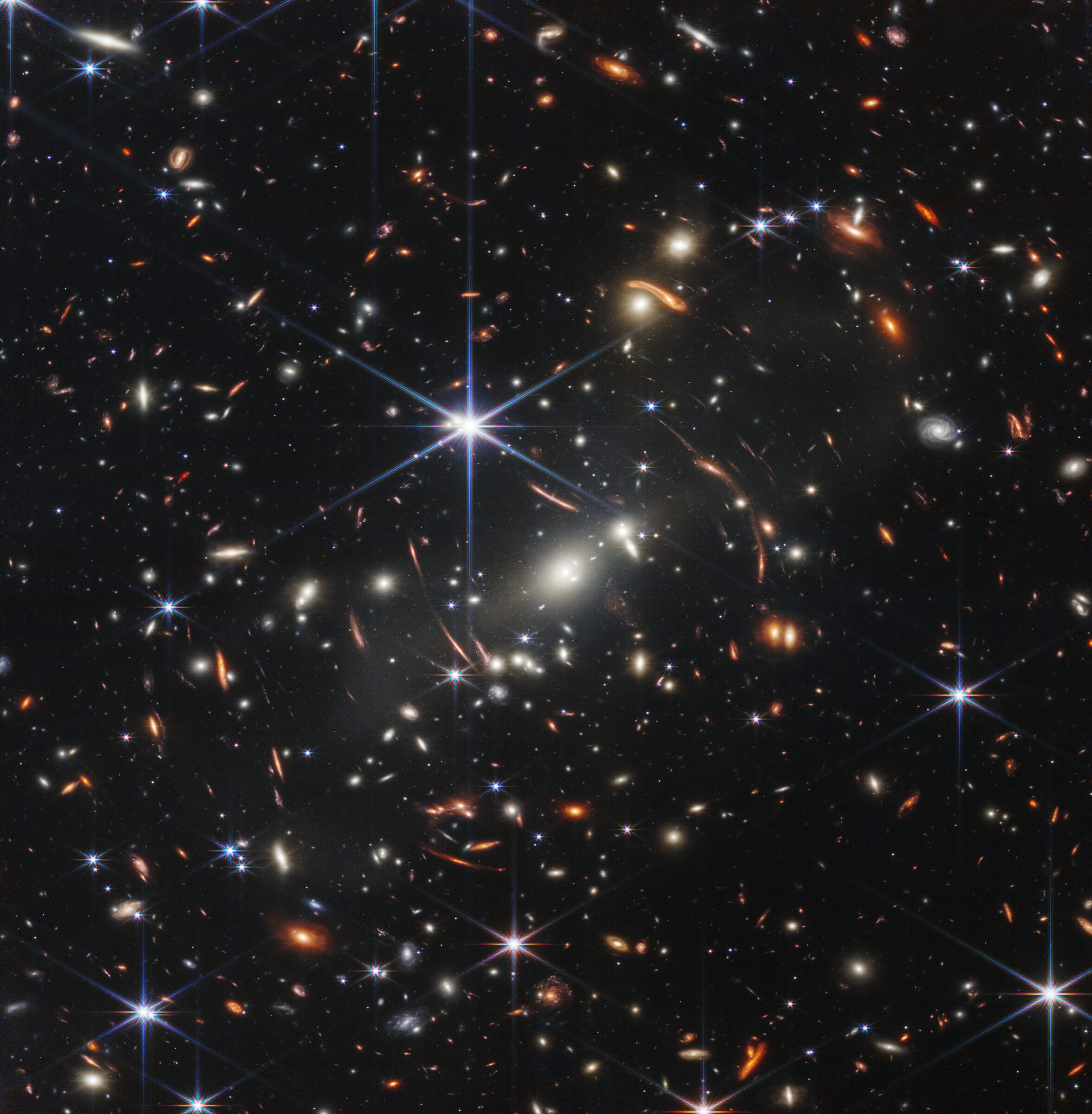
The Big Bang theory describes how the universe evolved from an extremely hot and dense state about 13.8 billion years ago. It was not an explosion in space: space itself began to expand, and it has been expanding and cooling ever since.
The first moments
In the first fraction of a second the universe was a hot soup of particles and radiation. Within about three minutes, protons and neutrons combined into the nuclei of the lightest elements: hydrogen, helium and a little lithium. Heavier elements such as carbon, oxygen and iron were made much later, inside stars.
The first light
For about 380,000 years the universe was so hot that light could not travel far. When it cooled enough for atoms to form, light was released for the first time. We still see this light today as the cosmic microwave background, a faint glow coming from every direction of the sky.
Evidence for the Big Bang
- Distant galaxies are moving away from us, and the farther they are, the faster they recede.
- The cosmic microwave background has exactly the properties predicted by the theory.
- The amounts of hydrogen and helium in the oldest stars match the predictions for the first minutes.
The James Webb Space Telescope now sees galaxies that existed only a few hundred million years after the Big Bang, helping astronomers understand how the first stars and galaxies formed.