
Ordinary matter makes up only about 5% of the universe. The rest is dark matter and dark energy, which we cannot see directly.
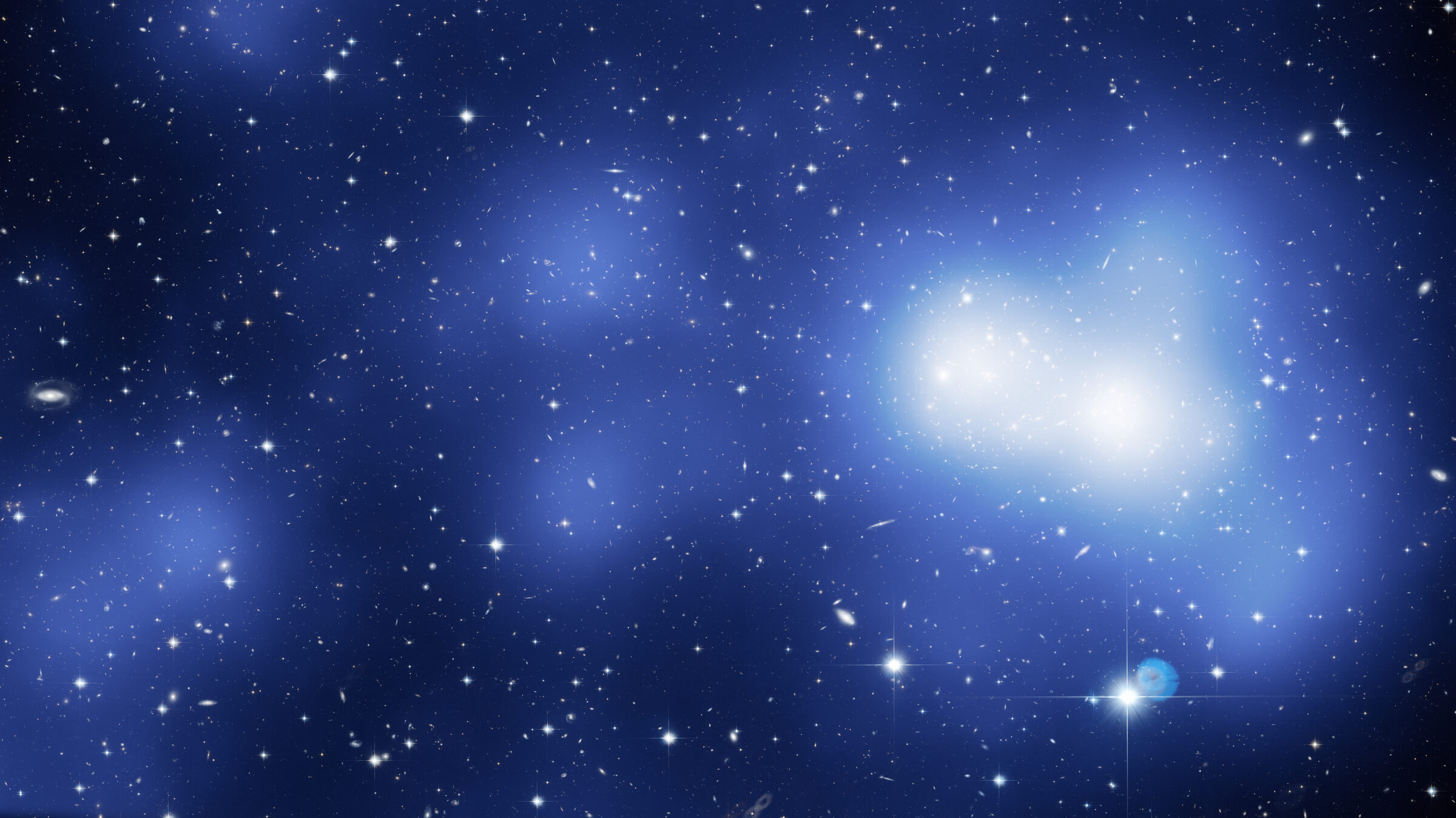
Everything we can see, from stars and planets to gas and dust, makes up only about 5% of the universe. The rest is invisible and we know about it only through its effects.
- Ordinary matter: about 5%
- Dark matter: about 27%
- Dark energy: about 68%
Dark matter
In the 1930s Fritz Zwicky noticed that galaxies in the Coma cluster move too fast to be held together by the visible matter alone. In the 1970s Vera Rubin found that the outer parts of spiral galaxies rotate just as fast as the inner parts. Both observations point to large amounts of unseen mass: dark matter.
Dark matter does not emit or absorb light, but its gravity bends the light of more distant galaxies. This effect, gravitational lensing, lets astronomers map where dark matter is, as in the blue overlay of the galaxy cluster MACS J0717 above.
Dark energy
dark energy is the name for whatever makes the expansion of the universe accelerate. It seems to be a property of space itself, and as space grows, there is more of it. What dark energy really is remains one of the biggest open questions in physics.