
It sounds like a unit of time, but a light-year measures distance. Here is how far it really is.
It sounds like a unit of time, but a light-year is a unit of distance: the distance light travels in one year. Light is the fastest thing in the universe, moving at almost 300,000 kilometres per second, so in one year it covers about 9.46 trillion kilometres.
Why we need it
Distances between stars are so large that kilometres become impractical. The nearest star after the Sun, Proxima Centauri, is about 40 trillion kilometres away. It is much easier to say that it is 4.24 light-years away.
Looking back in time
A light-year also tells us something remarkable: when we look at a star 100 light-years away, we see light that left it 100 years ago. The farther we look, the further back in time we see. That is how telescopes can observe galaxies as they were billions of years ago.
Read more about distances in space on the page The Scale of the Universe.
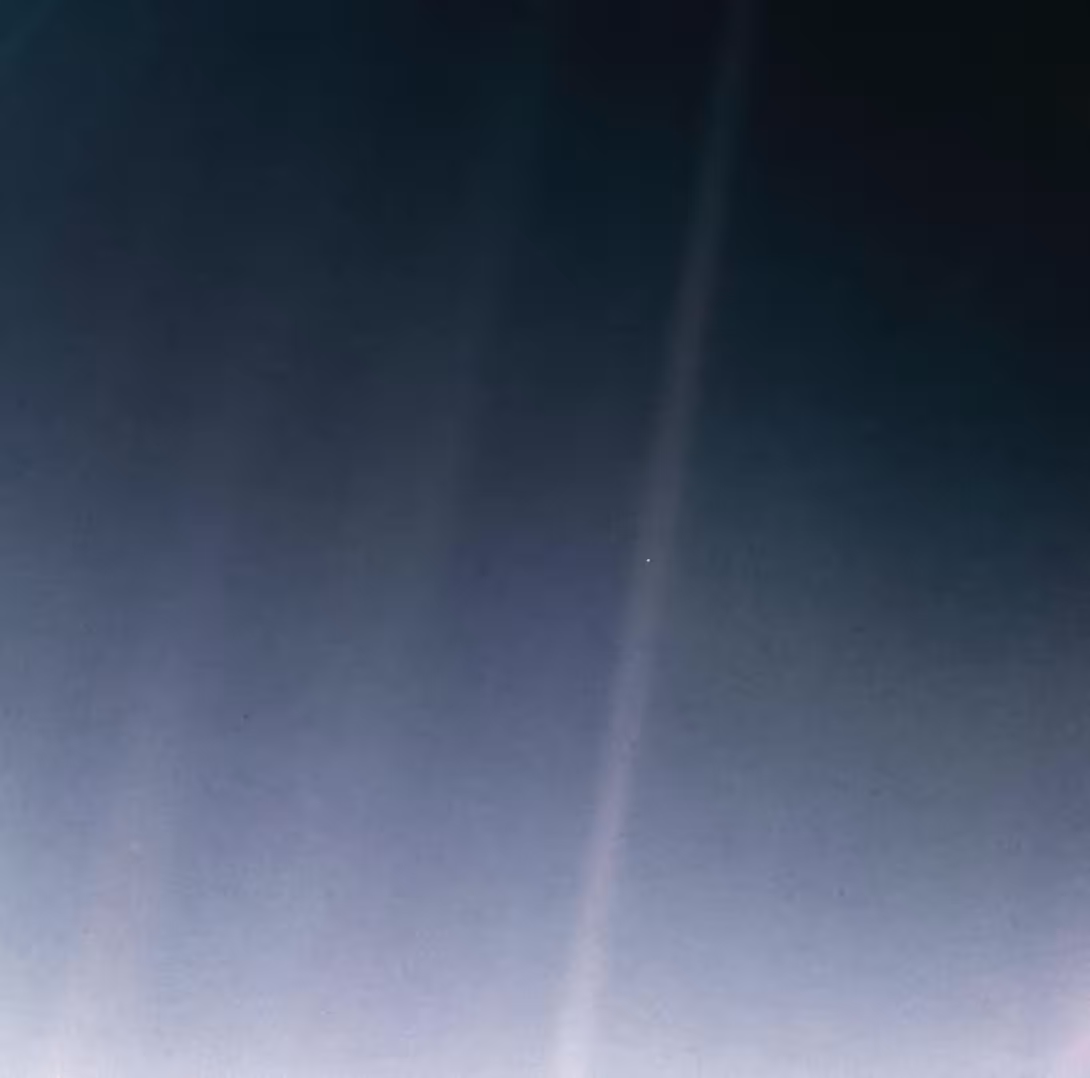
Image: Pale Blue Dot Revisited. Credit: NASA/JPL-Caltech. Source, NASA media guidelines.
Comments
I always thought it was a unit of time. Thanks for clearing that up!
In reply to by stargazer_ada
You are not alone, even some films get it wrong.
Nice article. One small addition for the curious: astronomers often prefer the parsec, which is about 3.26 light-years.
The name comes from "parallax second". As Earth orbits the Sun, nearby stars seem to shift slightly against more distant ones. A star at a distance of one parsec would shift by exactly one arcsecond, which is 1/3600 of a degree.
The European Gaia mission measured these tiny shifts for nearly two billion stars. If you want to dig deeper, the Gaia mission pages are a great place to start.
So when I look at the Andromeda Galaxy, I see light that is 2.5 million years old? Mind-blowing.