
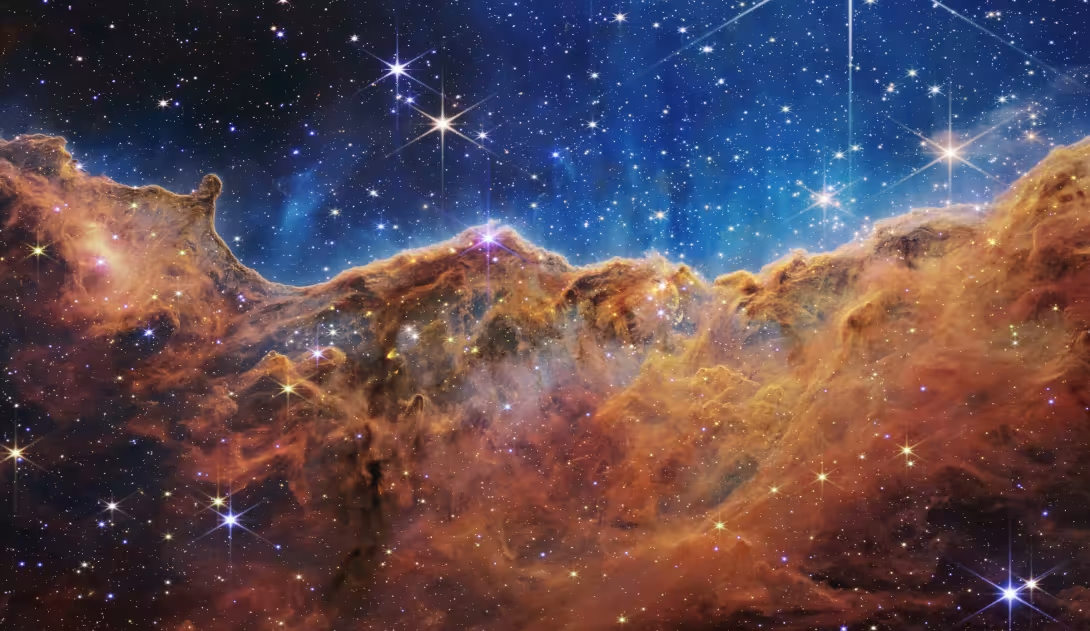
The James Webb Space Telescope observes infrared light, which our eyes cannot see. Here is why that matters.
Our eyes see only a narrow range of light. Just beyond red lies infrared light, which we feel as heat but cannot see. The James Webb Space Telescope was designed to observe exactly this part of the spectrum.
Seeing through dust
Stars are born inside dense clouds of gas and dust. Visible light cannot get through the dust, but infrared light can. That is why Webb's images of star-forming regions, such as the "Cosmic Cliffs" in the Carina Nebula, are full of young stars that were hidden from earlier telescopes.
Light from the first galaxies
As the universe expands, light travelling through it is stretched to longer wavelengths. Light that the first galaxies emitted as ultraviolet or visible light reaches us today as infrared. To see the earliest galaxies, a telescope must therefore be sensitive to infrared light.
Keeping cool
Infrared light is heat, so a warm telescope would be blinded by its own glow. Webb's sunshield, the size of a tennis court, keeps its mirror and instruments at below −220 °C.
Image: NIRCam Image of the "Cosmic Cliffs" in Carina. Credit: NASA, ESA, CSA, and STScI. Source, CC BY 4.0.
Comments
The Cosmic Cliffs image is my desktop wallpaper. Now I finally understand why it looks so different from older pictures.
Does Webb replace Hubble?
In reply to by Martin (not verified)
No, they complement each other. Hubble observes mostly visible and ultraviolet light, Webb infrared. Many studies combine data from both.